About the tool
The Recommendation Development Tool is a free, web-based application designed to support the systematic and transparent development of clinical practice guideline recommendations.
It provides an integrated workspace for managing PICO questions, documenting Evidence-to-Decision (EtD) judgments, classifying recommendations, applying methodological safeguards, formulating recommendation wording and exporting supporting documentation.
The tool is intended primarily for guideline-developing organizations, guideline panels, methodologists and research groups. It supports an iterative development process, allowing users to revisit and revise their assessments and recommendations.
Methodological foundations
The tool integrates two complementary methodological approaches:
Evidence-to-Decision frameworks: support structured assessment and documentation of panel judgments for intervention and diagnostic questions (1).
The Semmelweis Framework: supports recommendation classification according to evidentiary foundations, transparent integration of expert opinion and application of methodological safeguards (2).
The tool is intended for use following the evidence-review process and does not replace systematic reviews, critical appraisal or evidence synthesis.
Development of the Semmelweis Framework
The Semmelweis Framework was developed through a stepwise methodological process by guideline methodologists and clinicians experienced in clinical practice guideline development. The conceptual foundation of the Framework was established through a methodological review of 98 guideline manuals from organizations across clinical fields (3). This review addressed the lack of a widely accepted definition of expert opinion and a new evidence-based definition was synthesized.
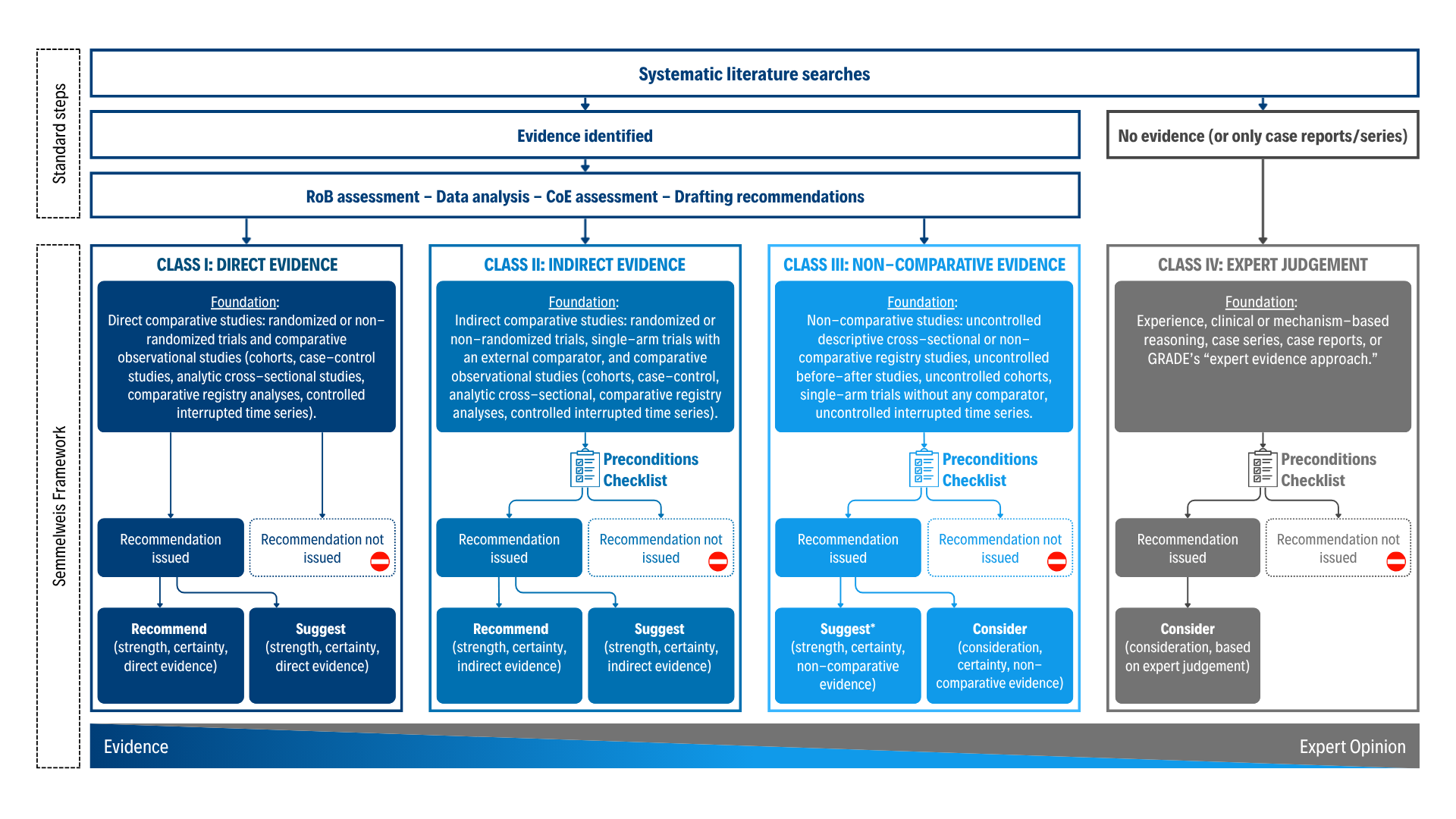
These foundations were subsequently translated deductively into a classification system for recommendations. The Framework defines four distinct classes of recommendations, each reflecting a different evidentiary foundation and the corresponding role of expert opinion. Direct comparative evidence was designated as Class I, indirect comparative evidence as Class II, group-level evidence without a concurrent comparator as Class III, and clinical experience, mechanism-based reasoning, case reports, case series, and collective panel judgment as Class IV (2).
These classes form a structured continuum: from recommendations based on direct comparative evidence to those relying entirely on expert judgment in the absence of relevant group-level evidence. As the certainty and directness of evidence decrease across the classes, the influence of expert opinion correspondingly increases.
Within this structure, “expert opinion” is retained as an overarching concept but is no longer used as a generic label for an individual recommendation. Instead, each recommendation is labeled according to the evidentiary foundation that most directly supports it. This makes the role of expert judgment explicit while also allowing panels to provide practical and actionable guidance when evidence is limited, inconclusive, or absent.
Semmelweis Framework flowchart
The flowchart summarizes the classification and recommendation pathway used by the tool.
Status and maintenance
The tool is free to use and requires no account or subscription. Project data are processed locally in the user’s browser. Users can save project files to their devices, and browser-based recovery copies may be stored locally. SEE EVIDENCE does not maintain a server-side database of user projects.
The Recommendation Development Tool is currently in public beta. Users are encouraged to report bugs and provide feedback to support its continued development and improvement. The website and recommendation development tool are hosted and maintained by SEE EVIDENCE: www.see-evidence.com.